Federal architecture represents one of the earliest surviving layers of Brooklyn’s residential history. Built primarily between the late 18th century and the 1830s, these homes predate the borough’s familiar brownstone streets and reflect the restrained classicism of the early American republic. Modest in scale but refined in detail, Federal houses helped establish the architectural foundation from which Brooklyn’s later residential styles would emerge.
Today, surviving examples are relatively rare, making them especially significant within the borough’s historic streetscape.
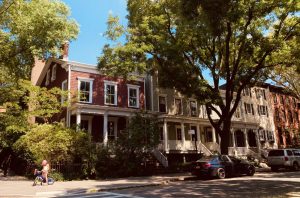
What Defines Federal Architecture?
Federal architecture developed in the United States following the Revolutionary War, drawing inspiration from Georgian and neoclassical English design. Compared to later Victorian styles, Federal homes are typically more restrained, emphasizing proportion, balance, and delicate ornament rather than heavy decoration.
In Brooklyn, common characteristics include:
- Symmetrical façades with evenly spaced windows
- Low-pitched or hidden rooflines
- Brick construction, often laid in Flemish bond
- Simple stoops or raised entries
- Fanlights and narrow sidelights around doorways
- Flat or subtly arched lintels above windows
- Delicate wood or iron detailing
The overall effect is understated and orderly, reflecting the architectural ideals of the early republic.
Why the Style Appeared in Brooklyn
Federal architecture emerged during a period when Brooklyn was still a relatively small collection of waterfront villages and farmland communities across from Manhattan. As trade expanded and ferry access improved in the early 19th century, residential development increased—particularly in areas close to the East River.
The style appealed to merchants and professionals seeking homesthat conveyed refinement without excessive ornament. Its orderly proportions and classical references aligned with the young nation’s interest in balance, civic virtue, and permanence.
By the mid-19th century, as Brooklyn urbanized more rapidly, Federal architecture gradually gave way to Greek Revival and Italianate styles, many of which were larger and more suited to denser rowhouse construction.
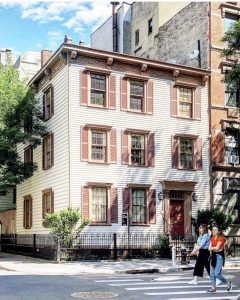
Where Federal Homes Can Be Found in Brooklyn
Because many early structures were later demolished or altered, intact Federal homes are relatively uncommon today. Surviving examples are concentrated in some of Brooklyn’s oldest neighborhoods:
- Brooklyn Heights — Home to some of the borough’s oldest surviving residences, Brooklyn Heights contains several well-preserved Federal row houses dating to the early 19th century.
- DUMBO — Though better known for industrial architecture, portions of the neighborhood retain early residential structures connected to Brooklyn’s waterfront development.
- Cobble Hill — Select blocks include transitional Federal and early Greek Revival homes reflecting the neighborhood’s gradual residential expansion.
- Vinegar Hill — One of Brooklyn’s oldest surviving residential enclaves, Vinegar Hill contains modest Federal-era row houses tied to the area’s maritime history.
Interior Characteristics
Federal interiors are typically more restrained than those of later 19th-century homes.
Common features include:
- Narrow but efficient floor plans
- Elegant staircases with delicate wood detailing
- Decorative fireplace mantels
- Modest ceiling heights compared to later brownstones
- Simple plaster moldings and refined proportions
Rather than emphasizing grandeur, these interiors prioritize balance, craftsmanship, and practicality.
An Important Link to Brooklyn’s Early History
Federal homes represent Brooklyn before the rise of the brownstone block—when the borough was still developing its identity as an independent city and commercial center. Their scale and simplicity provide a contrast to the heavier, more ornamental styles that would later dominate Brooklyn’s streets.
Today, these surviving houses serve as reminders of the borough’s earliest residential development and offer a rare glimpse into Brooklyn’s architectural beginnings.
If you are looking for advice in any part of evaluating a fixer upper, please feel free to contact me for resources and assistance at townhousetherapytati@gmail.com or call (917) 697-0117.