Brooklyn’s architectural history is often associated with brownstone rows and classical revival styles, but some of the borough’s most intriguing buildings date to an earlier and more expressive period. Gothic Revival homes, constructed primarily in the mid-19th century, represent one of Brooklyn’s earliest experiments in residential architectural identity. Inspired by medieval European forms, these buildings introduced drama, verticality, and ornament to a rapidly developing borough.
While Gothic Revival never achieved the widespread popularity of later styles, its surviving examples remain among Brooklyn’s most distinctive historic homes.
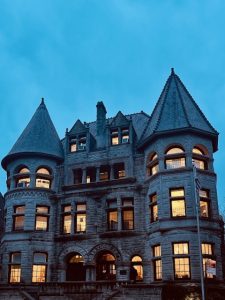
What Defines Gothic Revival Architecture?
Gothic Revival architecture draws from medieval English and continental European precedents, favoring expressive form over classical balance.
In residential settings, the style is characterized by:
• Pointed (ogival) arches over doors and windows
• Steeply pitched gabled roofs
• Narrow, vertically oriented windows
• Decorative wood trim, tracery, or carved stone
• Asymmetrical façades and irregular massing
• Occasional use of stained or leaded glass
Unlike Renaissance Revival or Italianate architecture, Gothic Revival does not rely on symmetry or strict proportion. Instead, it embraces variation and visual movement, creating buildings that feel picturesque and highly individual.
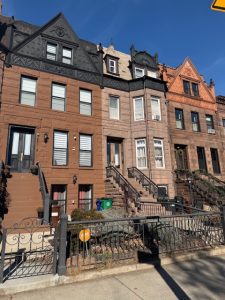
Why Gothic Revival Took Root in Brooklyn
Gothic Revival gained popularity in the United States between the 1840s and 1870s, a period when architectural taste shifted to
ward romantic and historical forms. In Brooklyn, the style aligned with early suburban development, when detached and semi-detached houses were common and neighborhoods encouraged architectural diversity.
This era preceded the dense rowhouse construction that would later define much of the borough. As land values rose and standardized rowhousing became dominant, Gothic Revival—less suited to uniform streetscapes—gradually gave way to Italianate, Romanesque Revival, and later Renaissance Revival styles.
Interior Characteristics
Inside, Gothic Revival homes often differ markedly from later brownstone layouts. Interiors may feature taller, narrower rooms, irregular floor plans, prominent staircases, and original wood or plaster detailing. Stained glass appears occasionally, adding to the atmospheric quality of these spaces.
Rather than formal or symmetrical, Gothic Revival interiors tend to feel intimate and expressive, reflecting the style’s emphasis on craftsmanship and mood.
A Rare but Important Legacy
Gothic Revival homes represent an early chapter in Brooklyn’sarchitectural evolution, when residential design favored individuality and emotional expression. Their scarcity today underscores their historical value, offering insight into a period before uniform rowhouse development reshaped the borough.
Preserved examples continue to enrich Brooklyn’s streetscape, reminding us that the borough’s architectural identity has always been diverse—and that even its quietest streets can reveal moments of bold architectural imagination.
Where Gothic Revival Homes Can Be Found in Brooklyn
Although relatively rare today, Gothic Revival homes can still be found across several neighborhoods:
• Brooklyn Heights features some of the borough’s earliest Gothic Revival residences, often blended with other mid-19th-century styles and marked by pointed arches and stone detailing.
• Clinton Hill and Fort Greene include isolated residential examples and prominent Gothic Revival churches that influenced surrounding streetscapes.
• Greenpoint is notable for its surviving Gothic Revival cottages, particularly wood-frame houses with steep roofs and decorative trim that recall Brooklyn’s early residential character.
• Park Slope and South Slope contain occasional Gothic Revival details, primarily in institutional or ecclesiastical buildings, with limited residential examples.
If you are looking for advice in any part of evaluating a fixer upper, please feel free to contact me for resources and assistance at townhousetherapytati@gmail.com or call (917) 697-0117.