Among Brooklyn’s historic residential styles, Queen Anne architecture stands out for its exuberance. Emerging in the late 19th century, these homes reflect a shift away from strict classical symmetry toward visual richness, texture, and individuality. Although best known in suburban Victorian enclaves, Queen Anne buildings appear throughout Brooklyn in forms ranging from freestanding villas to richly detailed rowhouses. Today, they remain some of the borough’s most visually dynamic historic residences.
What Defines Queen Anne Architecture?
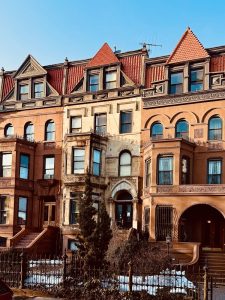
Despite the name, Queen Anne architecture has little connection to the early-18th-century English monarch. Instead, it represents a Victorian reinterpretation of earlier architectural traditions combined with new construction technologies and aesthetic freedom. Common defining features include:
• Asymmetrical façades and varied rooflines
• Turrets, bays, and projecting oriels
• Decorative brickwork, shingles, or mixed materials
• Elaborate wood trim, spindlework, and ornament
• Large porches or stoops emphasizing outdoor living
• Stained or leaded glass accents
The overall effect is intentionally picturesque, prioritizing individuality and visual complexity over formal balance.
Why the Style Flourished in Brooklyn
Queen Anne architecture became popular in the United States between roughly 1880 and 1910, coinciding with Brooklyn’s rapid residential expansion and its consolidation into New York City in 1898. Advances in mass-produced building materials allowed architects and builders to experiment with decorative detail at a scale previously impractical. In Brooklyn, the style appeared both in speculative rowhouse developments and in suburban-style enclaves where detached homes were feasible. Its emphasis on variety made it particularly appealing in newly developing neighborhoods seeking a distinctive identity.
Where Queen Anne Homes Can Be Found in Brooklyn
Several neighborhoods still display strong examples of Queen Anne residential design:
• Prospect Park South — Perhaps Brooklyn’s most concentrated collection, this planned late-Victorian enclave includes freestanding houses with turrets, wraparound porches, and richly textured façades.
• Park Slope — While dominated by brownstones, select streets feature Queen Anne rowhouses distinguished by patterned brickwork, stained glass, and decorative gables.
• Clinton Hill — Known for architectural variety, the neighborhood includes late-Victorian residences incorporating Queen Anne ornament alongside Romanesque Revival influences.
• Bedford-Stuyvesant — Some late-19th-century rowhouses here display Queen Anne characteristics, particularly in façade detailing and asymmetrical composition.
Interior Characteristics
Interiors of Queen Anne homes often reflect the same complexity seen on the exterior. Typical features may include:
• Varied room shapes rather than strictly rectangular plans
• Decorative fireplaces and wood paneling
• Stained or etched glass windows
• Prominent staircases and vestibules
• Rich plasterwork and period millwork
These interiors emphasize comfort, craftsmanship, and layered visual interest rather than strict formal symmetry.
A Distinctive Chapter in Brooklyn’s Residential History
Queen Anne architecture represents Brooklyn at a moment of optimism and expansion, when architectural individuality was embraced and decorative expression flourished. Though not as ubiquitous as brownstone rows, these homes contribute significantly to the borough’s architectural diversity. Their continued preservation offers insight into Brooklyn’s late-Victorian identity — one defined not by uniformity, but by texture, experimentation, and visual richness.
If you are looking for advice in any part of evaluating a fixer upper, please feel free to contact me for resources and assistance at townhousetherapytati@gmail.com or call (917) 697-0117.